Audit notes
We checked RoundSquare’s zero-axiom Lean proof against the Clay Yang–Mills statement
Published · Updated
We checked RoundSquare, the artifact behind this claim of a zero-axiom Lean 4 negative resolution of the Clay Yang–Mills mass-gap problem on non-compact (\mathbb{R}^4).
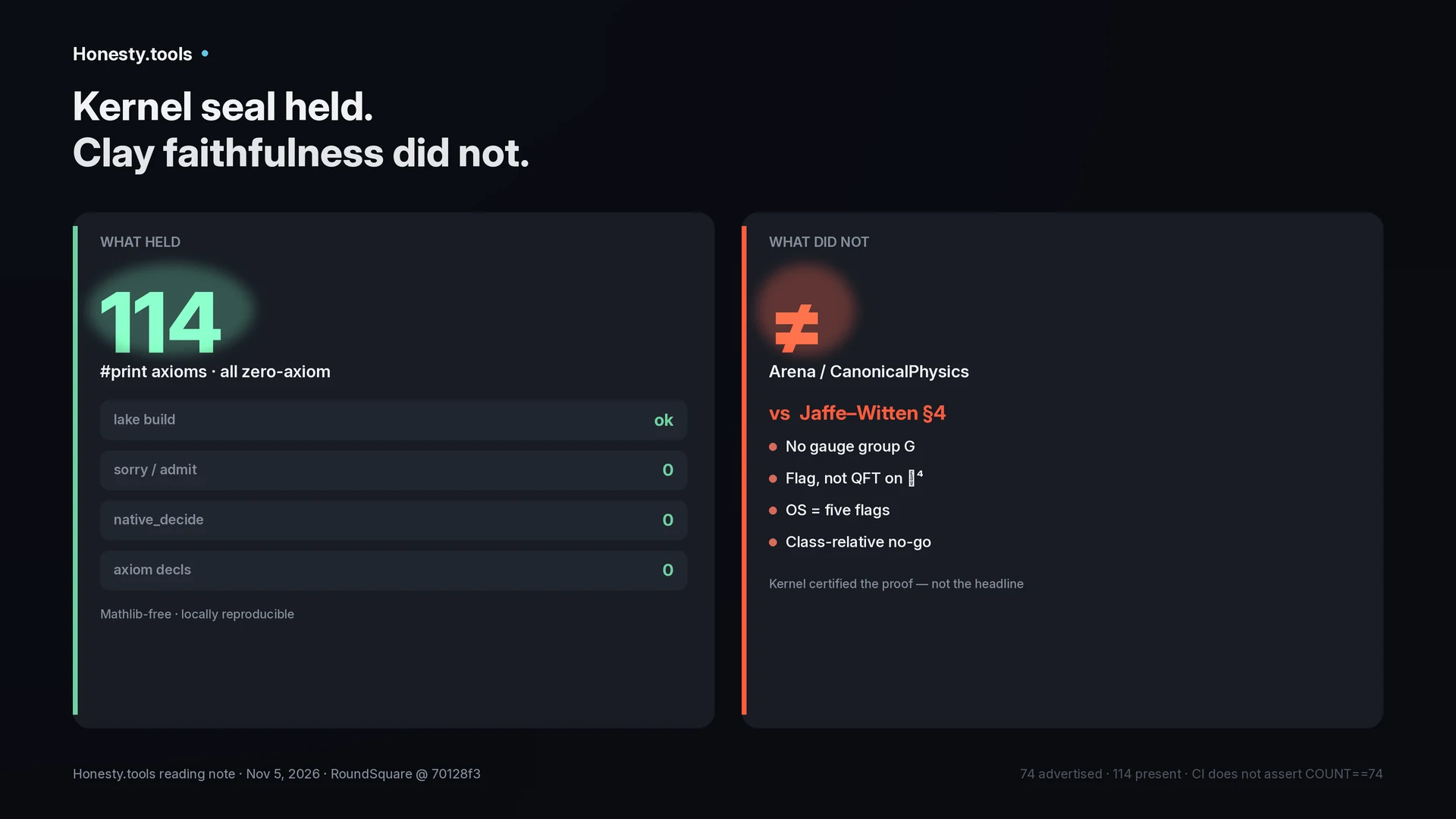
Here’s what held: the Lean kernel seal held. The repository builds, and 114 #print axioms checks report no axiom dependencies. Here’s what didn’t: the claim as a negative resolution of Clay Yang–Mills. The theorem lives inside an author-defined Arena / CanonicalPhysics ontology; it is not a faithful formalization of the existence-and-mass-gap statement in Jaffe–Witten §4.
That distinction is the finding. A kernel can certify a proof without certifying that its statement means what the headline says.
What the repository claims
The README and file header describe a:
“World's First Zero-Axiom Machine-Verified Negative-Result Resolution (Impossibility Theorem) of the Clay Millennium Yang–Mills Problem on Pure Non-Compact (\mathbb{R}^4).”
The core displayed implication is:
[ \mathrm{CanonicalPhysics}(\mathbb{R}^4) \land \mathrm{OS} \land (\Delta > 0) \Longrightarrow \bot. ]
A companion claim says the mass gap is “automatic” on the compact manifold (S^4 \times T^3). That story is mostly in YM_V5.pdf; the Lean development’s Section 30 instead derives ¬ nonCompact under assumed Strocchi-style laws and ClayPair.
What we ran
We audited commit 70128f365357ba6ab661c0e8a822c05d1f5c2190, using the repository’s leanprover/lean4:v4.11.0 toolchain.
| Check | Result |
|---|---|
Local lake build |
Success, exit 0, approximately 8 seconds |
Local lean RoundSquare.lean |
Success, exit 0 |
#print axioms directives |
114 |
| Local “does not depend on any axioms” results | 114 |
GitHub Actions run 42075796526 at commit 70128f3 |
Success: “Lean 4 Zero-Axiom Kernel Verification” |
axiom declarations in code |
0 |
sorry / admit proof terms |
0; the words occur only in comments/documentation |
native_decide |
0 |
unchecked / trusted / opaque / unsafe |
0 |
| Mathlib imports or dependency | 0; standalone Lean file |
Classical.choice, propext, Quot.sound dependencies in audited theorems |
None, according to #print axioms |
This is a real, locally reproducible, Mathlib-free Lean artifact. The mechanical zero-axiom claim held at this commit. It is not a claim we checked only by reading the README: we built the code and ran Lean’s axiom reports.
Faithfulness: RoundSquare versus Jaffe–Witten §4
The official Clay statement, by Arthur Jaffe and Edward Witten, asks in §4:
Yang–Mills Existence and Mass Gap. Prove that for any compact simple gauge group (G), a non-trivial quantum Yang–Mills theory exists on (\mathbb{R}^4) and has a mass gap (\Delta > 0). Existence includes establishing axiomatic properties at least as strong as those cited in [45, 35] (Streater–Wightman; Osterwalder–Schrader).
The comparison is about the statement given to Lean, not about whether Lean checked that statement correctly.
| Clay requirement | What RoundSquare.lean contains |
|---|---|
| A nontrivial quantum Yang–Mills theory for every compact simple gauge group (G) | No (G) parameter; no connection, curvature, Wilson loop, or continuum measure |
| Existence on non-compact (\mathbb{R}^4) | nonCompact : Prop, a flag in the author’s Arena structure |
| A mass gap (\Delta > 0) in the spectrum of the Hamiltonian | A strictGap proposition and toy spectral constructions, not the spectrum of a self-adjoint Hamiltonian on a QFT Hilbert space |
| Axioms at least as strong as Osterwalder–Schrader / Wightman | OS is five flags; stub correlators stand in for OS axiom schemas over distributions |
| The Clay existence-and-mass-gap problem | A proof that OS ∧ Gap is incompatible with a custom CanonicalPhysics / InCompleteR4GaugeClass class |
| Compact manifolds as an intermediate problem, not a replacement for (\mathbb{R}^4) | Lean derives ¬ nonCompact under assumed laws; the (S^4 \times T^3) “automatic gap” promotion is mostly PDF-side |
Arena is a structure of proposition fields. Gap A is A.strictGap, and ClayPair A is OS A ∧ Gap A. The structures MethodI_Physics through MethodIV_Physics include the physics implications themselves as fields—for example, an arrow from gap and Gribov-copy assumptions through restriction and complex poles to negated reflection positivity. CanonicalPhysics packages those four methods. The no-go theorem then chains the packaged arrows.
That is valid Lean. But it establishes the incompatibility relative to the encoding. It does not formalize Singer, Strocchi, or Gribov–Zwanziger from first principles, and it does not negatively resolve Jaffe–Witten’s QFT existence problem.
The compact/non-compact distinction is named correctly in the headline. The faithfulness miss is not that the repository forgot non-compactness; it is that the formal statement does not encode Clay’s QFT object.
The useful part: ArenaDefect partially documents the bridge gap
The file contains an unusually candid internal check. Sections 25–28, including ArenaDefect_maximal_honest_statement and ArenaDefect_v4_status, machine-verify that:
- class-relative exclusion holds inside
CanonicalPhysics/InCompleteR4GaugeClass; - bridges from “every physically admissible YM” or “every YM axiom package” into that class are not logical truths in the current ontology (
ArenaDefect_v4_physical_bridge_is_not_a_logical_truthandArenaDefect_v4_abstract_bridge_is_not_a_logical_truth); - an artificial
UnconstrainedCompatibleModelsatisfies the bare conjunction outside that class.
Section 29 then defines PhysicallyAdmissibleR4YangMills essentially as the infrared dichotomy that supplies the bridge, proves PhysicalAdmissibilityBridge for that predicate, and obtains unconditional_prize_level_physical_no_go relative to it.
So “unconditional” here means unconditional after admissibility has been identified with the obstructing class’s closure properties—not unconditional over every construction Clay would accept. The author’s ArenaDefect sections partially document this gap before Section 29 closes it by definition.
The count mismatch: 74 advertised, 114 present
The README and CI job title say 74. The source contains 114 #print axioms directives, and our local run produced 114 “does not depend on any axioms” results.
The workflow step titled “Audit All 74 Theorems for Zero Axioms” checks Lean output for sorryAx, Classical.choice, propext, and Quot.sound, and counts successful reports. It does not assert that the count equals 74. Green CI therefore does not reconcile the advertised count with the artifact. This is a count mismatch, not a hidden-axiom finding.
What we are and are not saying
We are saying the build, CI, static scan, and 114 zero-axiom reports held at the pinned commit. We are also saying the formalized statement is not a faithful negative resolution of Jaffe–Witten §4.
We are not saying the Lean proofs are broken, that the repository secretly uses sorry, or that the author’s physics intuition is disproved by this note. The question is narrower: what did the kernel actually check?
A zero-axiom proof can be mechanically sound and still answer a different question from the one in the headline. RoundSquare is a clear teaching case for that distinction—and its own ArenaDefect section is the best place to start reading it.
Sources and pinned receipt
- Claim post: https://x.com/dr_logvinovich/status/2118380634343105007
- Repository: https://github.com/Dr-Logvinovich/round-square
- Audited HEAD:
70128f365357ba6ab661c0e8a822c05d1f5c2190 - Official Clay statement, Jaffe–Witten §4: https://www.claymath.org/wp-content/uploads/2022/06/yangmills.pdf
RoundSquare.lean: 153,907 bytesRoundSquare.leanSHA-256:c2b76dd199f17fc50acffad25d4adeeee79afa31a3d4e5622c04082266366461
Receipts: Ford’s STATUS.md, RECEIPT.txt, and FAITHFULNESS.md for RoundSquare at commit 70128f365357ba6ab661c0e8a822c05d1f5c2190 (Nov 5, 2026). Public claim text from the repository README (tweet body was not fetched); it matches Scout’s brief.