Audit notes
We checked Axiom’s Weil conjectures Lean release
Published · Updated
We checked Axiom’s Weil conjectures release against the public repo AxiomMath/Weil at commit 27cdb2049be62ee2911429b47f54774078450e32 — the Lean project built on the Stacks library we looked at yesterday.
Here’s what held on a light static pass: across 980 tracked .lean files, the masked scan found no sorry, admit, native_decide, or added axiom declarations in code, and the four headline theorems — rationality, the functional equation, the Riemann hypothesis over finite fields (Deligne), and the Betti-number statement — each map to a named Lean declaration with a Freitag–Kiehl citation trail. Here’s what this note is not: a successful build, a #print axioms enumeration, or a verdict on the “under 24 hours” timeline.
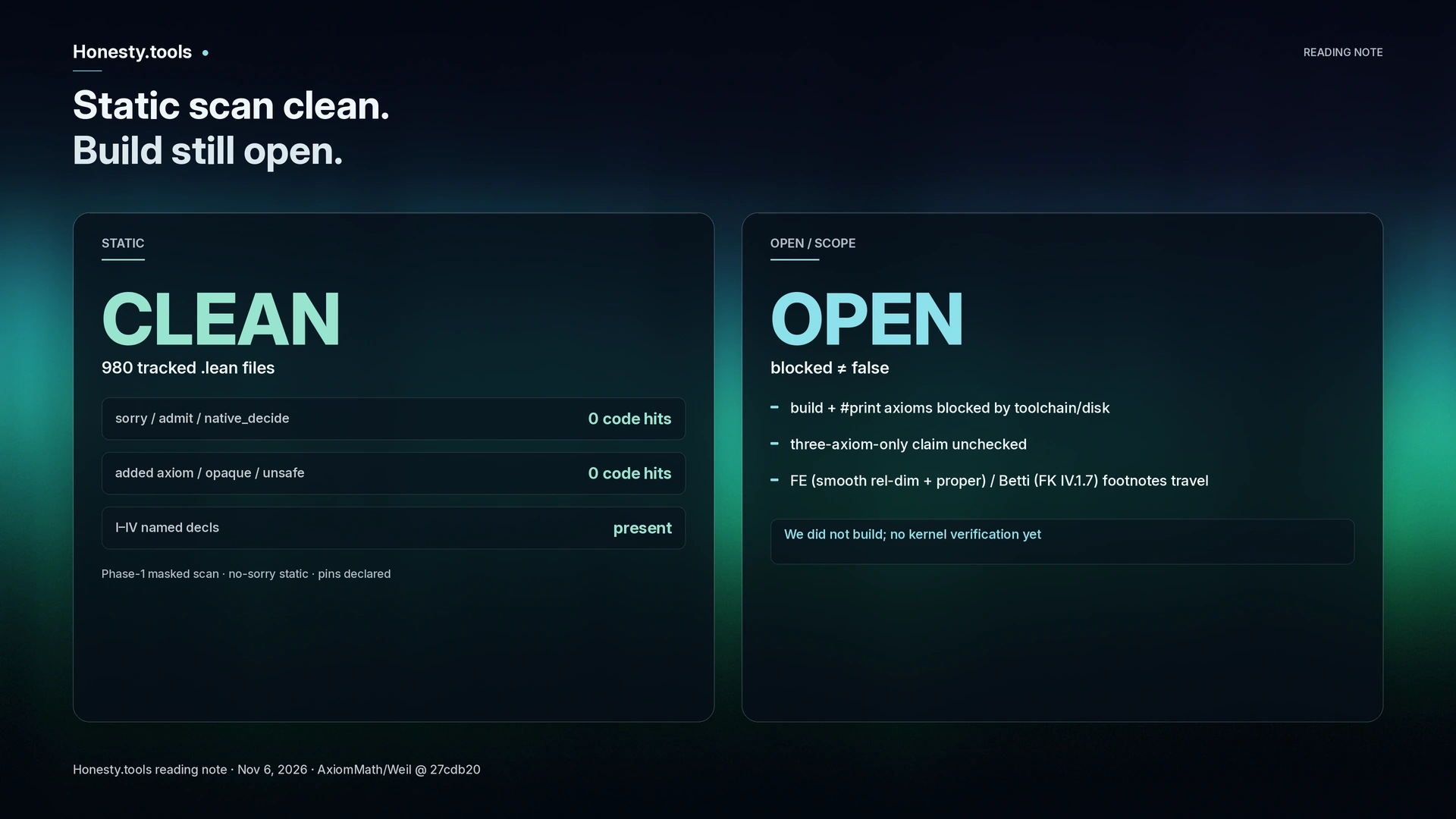
That scope line is the finding. The build and #print axioms are blocked by our environment, not by anything we found in the math — so the kernel-checks-every-proof and three-axiom claims stay open, and blocked ≠ the theorems are false.
What the release claims
The README presents a Lean formalization of all four Weil conjectures following Freitag–Kiehl (1988), built on Mathlib plus AxiomMath’s own Stacks / StacksFrontier dependency. It states the proofs use no sorry, no native_decide, and no added axioms; that Lean’s kernel checks every proof; and that only the three standard axioms (propext, Classical.choice, Quot.sound) appear. The accompanying tweet adds a process claim — the formalization was completed in under a day.
On this light pass we checked the static claims and the presence of the named theorems. The build-dependent claims and the timeline claim we left unverified.
What we checked
Ford’s light receipts pass (America/Denver, Nov 6, 2026) pinned the repo at 27cdb20…e32 and ran a Lean-aware masked scan (comments/strings masked) over the tracked .lean corpus.
| Gate | Result |
|---|---|
| Phase-1 static escape scan (980 files) | PASS — 0 code hits for sorry / admit / sorryAx / native_decide / ofReduce* / added axiom / opaque / unsafe / skipKernelTC |
| I–IV named declarations present | PASS (static presence) — exists_mul_zetaSeries_eq; prod_aeval_inv_rationalFrobeniusCharpolyReverse_zpow_eq; satisfiesWeilEstimate (+ classical product form); natDegree_rationalFrobeniusCharpolyReverse_eq_bettiNumber |
| Declared dependency pins | PASS — Stacks 012108f61d7f…, Mathlib 16edf57de7…, toolchain v4.34.0-rc2 |
| Freitag–Kiehl citation trail | Consistent — module docs cite FK Intro / II.4 / IV.1 / IV.1.7 |
| Phase-2a faithfulness sample (n=5, nonrandom) | Spot check only — 3 match, 1 documented adaptation, 1 narrower-than-casual-reading |
lake build |
BLOCKED — toolchain v4.34.0-rc2 absent on the box; disk tight |
#print axioms |
BLOCKED — depends on build |
| “Under 24 hours” timeline | Unverified — git author dates ≠ wall-clock swarm duration |
The eight set_option maxRecDepth hits are benign elaborator limits, not trust escapes; no debug.skipKernelTC appeared. Dependency code (Stacks/Mathlib) was not re-scanned in this drop.
Method footnotes
Functional equation — documented adaptation. The README prose says “smooth and projective,” but the Lean theorem DeligneFunctionalEquation.lean:341 assumes smooth of relative dimension n plus proper. The module docstring notes this itself: FK uses smooth-projective, the formalized hypothesis is the smooth-relative-dimension-plus-proper form. The conclusion shape matches the README’s displayed formula. We report the adaptation; we did not re-derive which hypotheses the proof truly needs.
Betti numbers — good-reduction setup, not universal. BettiNumber.lean:48 gives deg P_ν = b_ν(Y) only under the FK IV.1.7 good-reduction comparison (ArisesByGoodReduction plus smooth-projective over a finite field and over ℂ). That matches FK, but it is weaker than an unqualified claim that every Weil P_ν degree equals a Betti number without comparison data. The module itself flags the bettiNumber/finrank subtleties.
Sample ≠ rate. The n=5 faithfulness read (3 match / 1 intentional adaptation / 1 narrower) is a nonrandom spot check tied to the README’s I–IV wording, not an estimated fidelity rate and not a second mathematical review of the two flagged items.
Line counts aren’t verification. 980 files and ~213k physical newlines describe the corpus we scanned. They are not a measure of verified mathematics; “no added axiom” as a property of the compiled theorems still needs #print axioms.
What we are and are not saying
We are saying the released artifact is checkable, its tracked .lean corpus passes a masked static escape scan, the four headline theorems are present as named declarations with a consistent FK citation trail, and two hypothesis footnotes (functional equation, Betti numbers) are documented in the code itself and travel with any summary.
We are not saying the theorems are kernel-verified, that only three axioms are used, that the build succeeds, or that the “under 24 hours” timeline is confirmed. The build and #print axioms are blocked by our environment (toolchain v4.34.0-rc2 plus disk), and blocked says nothing either way about the math. Dependency code and generated/transitive declarations are outside this pass.
A released, checkable artifact with a clean static scan is a real signal — and it is a different signal from a kernel-verified proof. Axiom’s Weil release is a useful teaching case for keeping those two apart until a full build and #print axioms run.
Sources and pinned receipt
- Claim post: https://x.com/axiommathai/status/2118689554085646813
- Repo: https://github.com/AxiomMath/Weil @
27cdb2049be62ee2911429b47f54774078450e32 - Toolchain:
leanprover/lean4:v4.34.0-rc2 - Stacks dep:
012108f61d7f92a6ffc35ec3f263b6da5d438125; Mathlib dep:16edf57de7933555826307a3d81b4391a3657a09 - Reference edition: Freitag–Kiehl, Étale Cohomology and the Weil Conjecture, Springer EM 13, 1988
Receipts: Ford’s STATUS.md, RECEIPT.txt, CLAIM_MAP.md, FAITHFULNESS.md, and scan_out.json for the C14 AxiomMath/Weil light pass (Nov 6, 2026, America/Denver). Verdict: Phase-1 static clean; Phase-2b build and #print axioms blocked by environment. Ford interest: 8/10.